RBC needed to route its women entrepreneur clients into a financial literacy course hosted on WBE Canada's members-only platform, with no shared login between the two organizations. I designed the end-to-end journey within hard technical and legal constraints, turning a one-way content link into a channel that brought 50 qualified leads into WBE Canada's pipeline.
UX Designer (lead for WBE Canada)
Figma, FigJam, WordPress, AccessAlly, ActiveCampaign
Q4 2024 - Q1 2025
RBC, a founding member of WBE Canada, launched a Women in Business initiative in 2024 with two dedicated web pages of resources for women-owned businesses. On those pages, they wanted to promote a Financial Literacy course they had built with WBE Canada, hosted on Toolbox, WBE Canada's members-only resource library.
I led WBE Canada's side of the project, designing a journey that let RBC's clients move from RBC's website into a members-only platform, access the specific course, and find their way back, all without a shared login between the two organizations. I owned the discovery, the stakeholder relationships across both organizations, and the end-to-end design of the access flow and supporting touchpoints.
I joined the project with a goal but no requirements, and much of the early work was defining the problem itself.
RBC wanted the course to be exclusive to their clients. WBE Canada wanted to protect its members-only content, but saw the collaboration as a rare chance to reach new businesses and build relationships beyond a static link.
Neither goal was straightforward to deliver, because the two platforms had no shared authentication system and Toolbox carried technical constraints that shaped what was possible. Three experience gaps defined the work:
Toolbox couldn't store passwords at signup, so first-time users had to create an account and set a password across separate steps instead of one seamless flow, which required guess-work for users.
The course lived inside a platform built for returning members, not first-time visitors, making it hard for RBC clients to find and reach the content they came for.
Once users landed on WBE Canada's site, there was no path back to RBC, leaving them stranded between two disconnected platforms.
I framed success around four outcomes that balanced both organizations' interests:
So RBC clients could reach the course without confusion or delay.
To the course rather than forcing users to browse or search Toolbox.
So users understood the handoff from RBC to WBE Canada and could return to RBC at any point.
So members-only resources stayed secure and WBE Canada could follow up with interested users without compromising RBC client privacy.
Because I started with no requirements, discovery meant aligning two organizations before I could design anything.
I first met with my WBE Canada team to define what we wanted from the collaboration. The insight that shaped everything: we didn't want to be just a link on RBC's website. WBE Canada is built on personal relationships, so I looked for ways to turn a one-way content handoff into a chance to actually connect with interested businesses.
I then met with RBC's Director of Women in Business and their Marketing Manager, and structured my questions around five themes to convert an open-ended goal into real requirements: data collection and privacy, branding, course availability, access and promotion, and client verification.That conversation surfaced the constraints that defined the project:
RBC wanted the course restricted to their clients, but neither platform could authenticate RBC user identities. Building a verification system would have required custom development beyond the project's scope and budget.
WBE Canada lacked a framework to track and keep updated with interested users. We couldn’t mass-email everyone who signed up – that would be compromising privacy of RBC clients. However, we needed a safe way to remain in contact with individuals who were interested in learning about our services but ones that would not reach out themselves.
Users expected to stay within, or easily return to, the RBC experience. Technically, there was no way to send them back to the exact page they came from. That would mean RBC clients would lose clients clicking into our platform
Toolbox assumed users were already familiar with WBE Canada's login process. First-time RBC clients weren't, and the platform's inability to set a password at signup meant a multi-step process was unavoidable, one that users who are new to the platform, are unaware of.
One early lesson: one question led to another. A branding question pulled in RBC's branding team, which pulled in legal, which reshaped timelines.
Rather than force solutions the platforms couldn't support, I made a series of deliberate tradeoffs within real constraints.
With no shared authentication and no budget for custom verification, I recommended an honour-system approach: gate the course behind an access page rather than verified credentials. The risk of misuse was low by design. The course was only linked from two specific RBC pages, was never promoted publicly, and the registration step itself filtered out anyone not genuinely trying to reach it. This protected members-only content while meeting RBC's exclusivity intent at a cost both organizations could accept.
To meet WBE Canada's goal of connecting with new businesses without violating RBC client privacy, I designed an opt-in pipeline. Users could choose whether they wanted to hear from WBE Canada.
That option split the pipeline into two buckets. Users who opted in to stay in touch received a welcome email introducing WBE Canada and were assigned a team member to reach out personally. Users who didn't, received only the RBC course intro email with login instructions and a completion email. The privacy line stayed intact, and WBE Canada gained a real channel to qualified leads.
I couldn't remove the password-reset step, but I could reduce the friction around it. I lifted the onboarding and terms requirements that normal Toolbox members complete, since RBC clients were only there for RBC's content. That got users into the course immediately on first login.
The remaining gap was the return visit, when users needed a password Toolbox hadn't let them set. I designed a multi-channel experience to close it: a clear notice before signup telling users to expect an email, followed by a step-by-step password-setup email with every link they'd need. This became the foundation for the opt-in communication flow as well.
Since the platforms weren't interconnected, I couldn't return users to their exact origin page. Instead of leaving them stranded, I routed the return button to RBC's main Women Entrepreneurs initiative page, one or two clicks from where they started. I also added an in-course touchpoint promoting both WBE Canada's certification and pathfinder programs and RBC's initiative, so the connection between the two organizations stayed visible throughout.
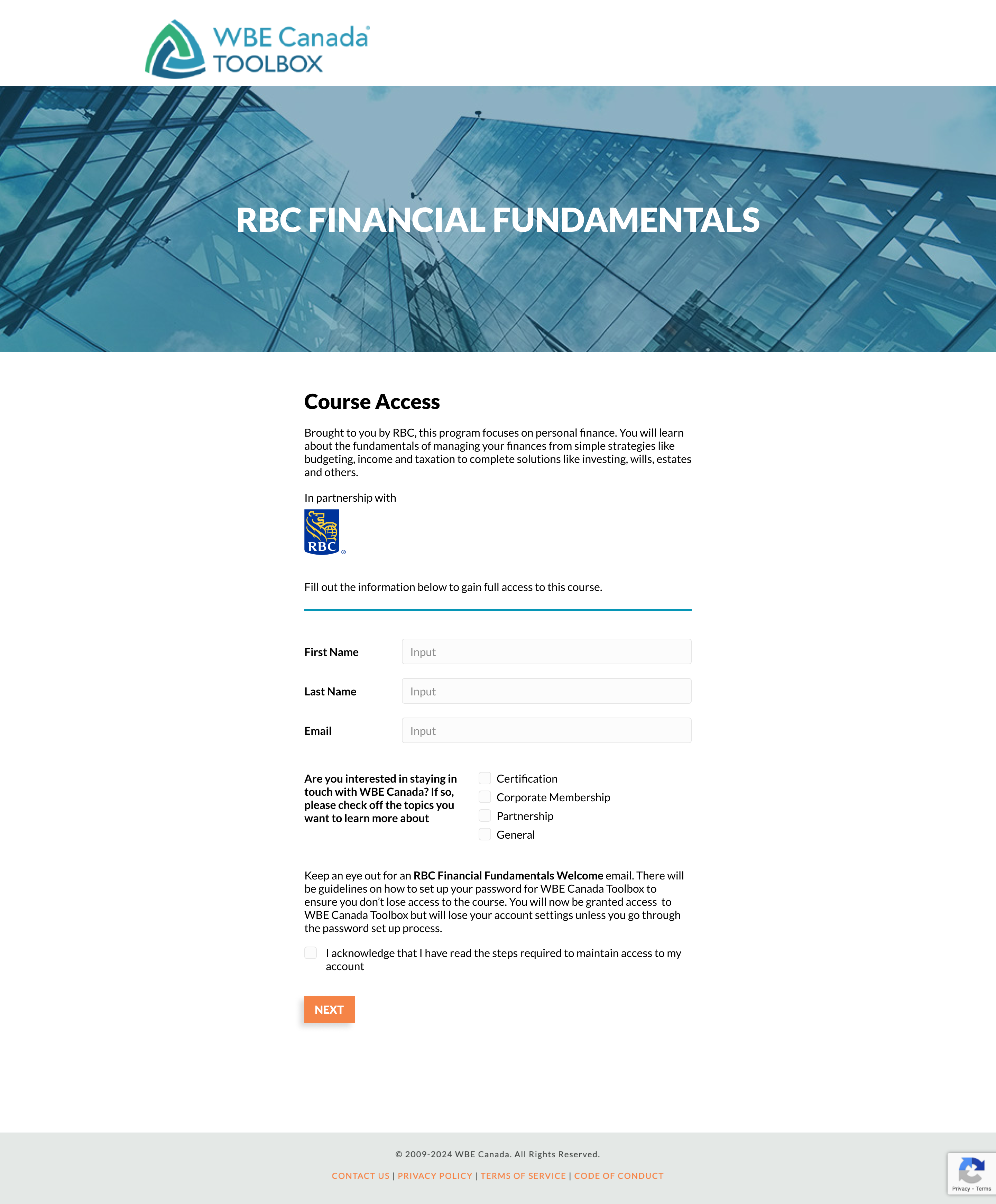
The access page went through several rounds. Early concepts explored richer questions about what users wanted from WBE Canada, which the form plugin couldn't support, so I stripped the interaction down to a single meaningful question: whether users wanted to stay in touch. Constraint drove clarity.

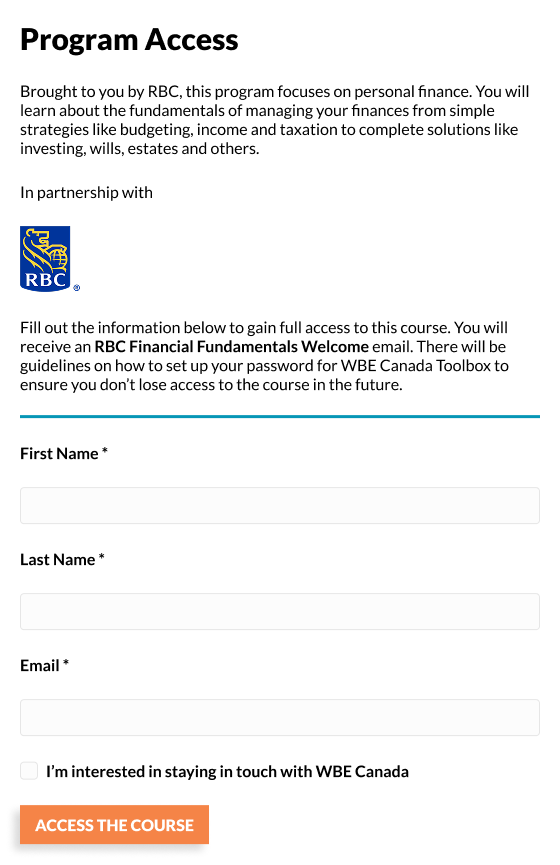
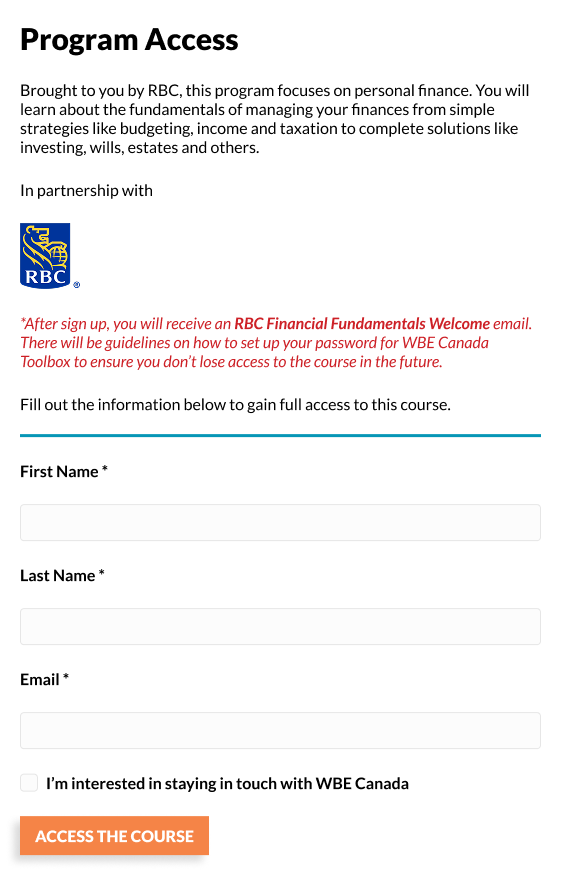
The first-time-user notification also took several iterations. In a check-in with RBC, they flagged that the notice for users unfamiliar with the platform wasn't clear enough, so I reworked the design to make the upcoming-email message hard to miss.
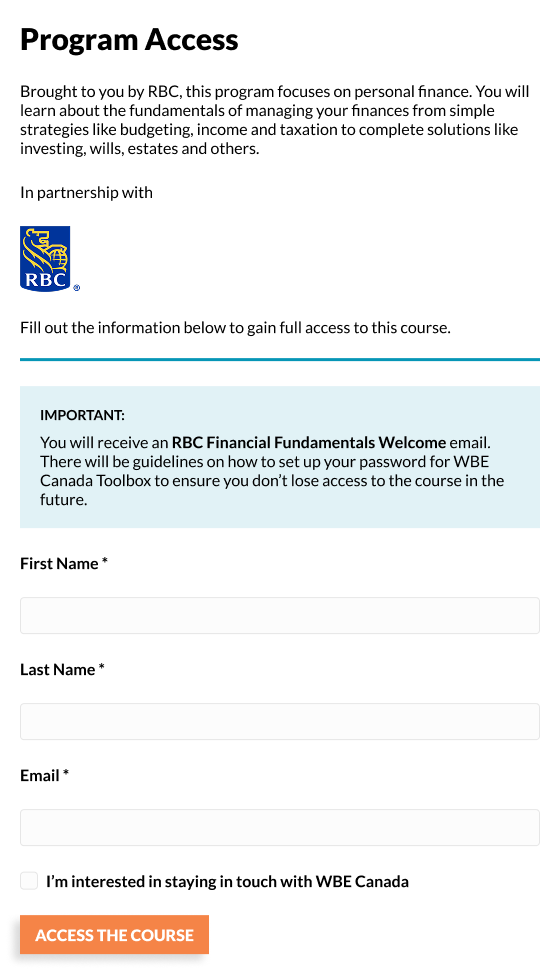
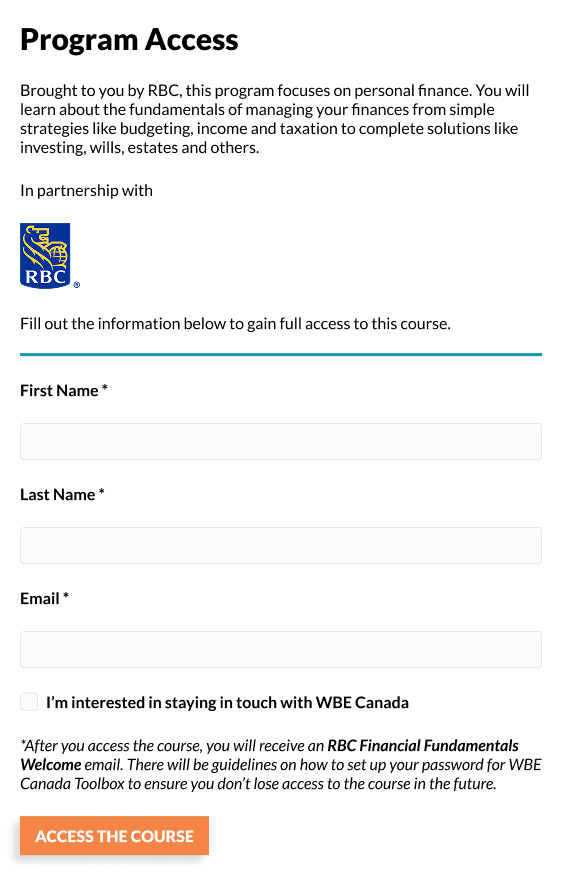
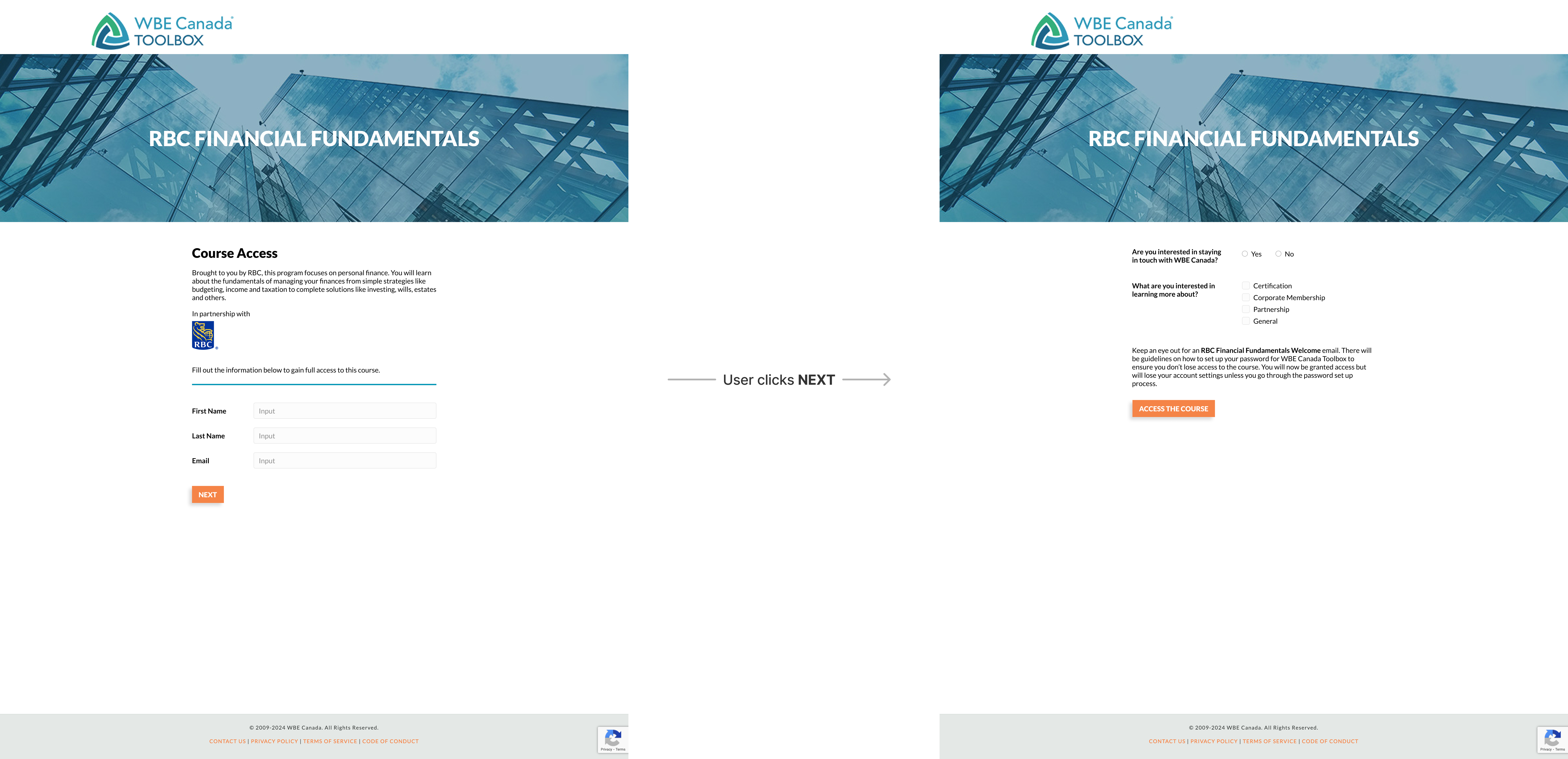
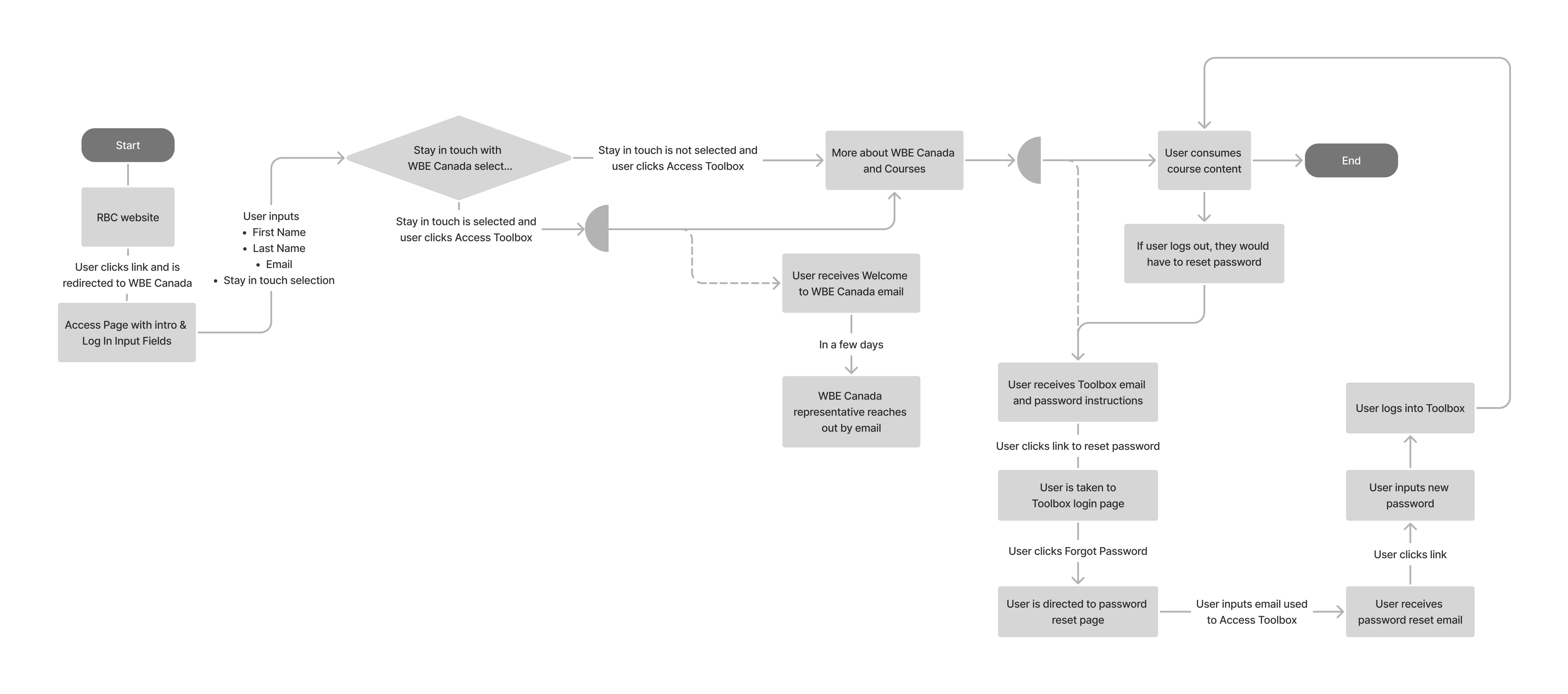
To bring both organizations onto the same page, I built a high-fidelity and low fidelity user flow, covering the full experience, from the access page through login to the stay-in-touch decision. I walked WBE Canada's team through it to confirm alignment with our original goal, then prepared and presented the full flow to RBC. The RBC team approved it.
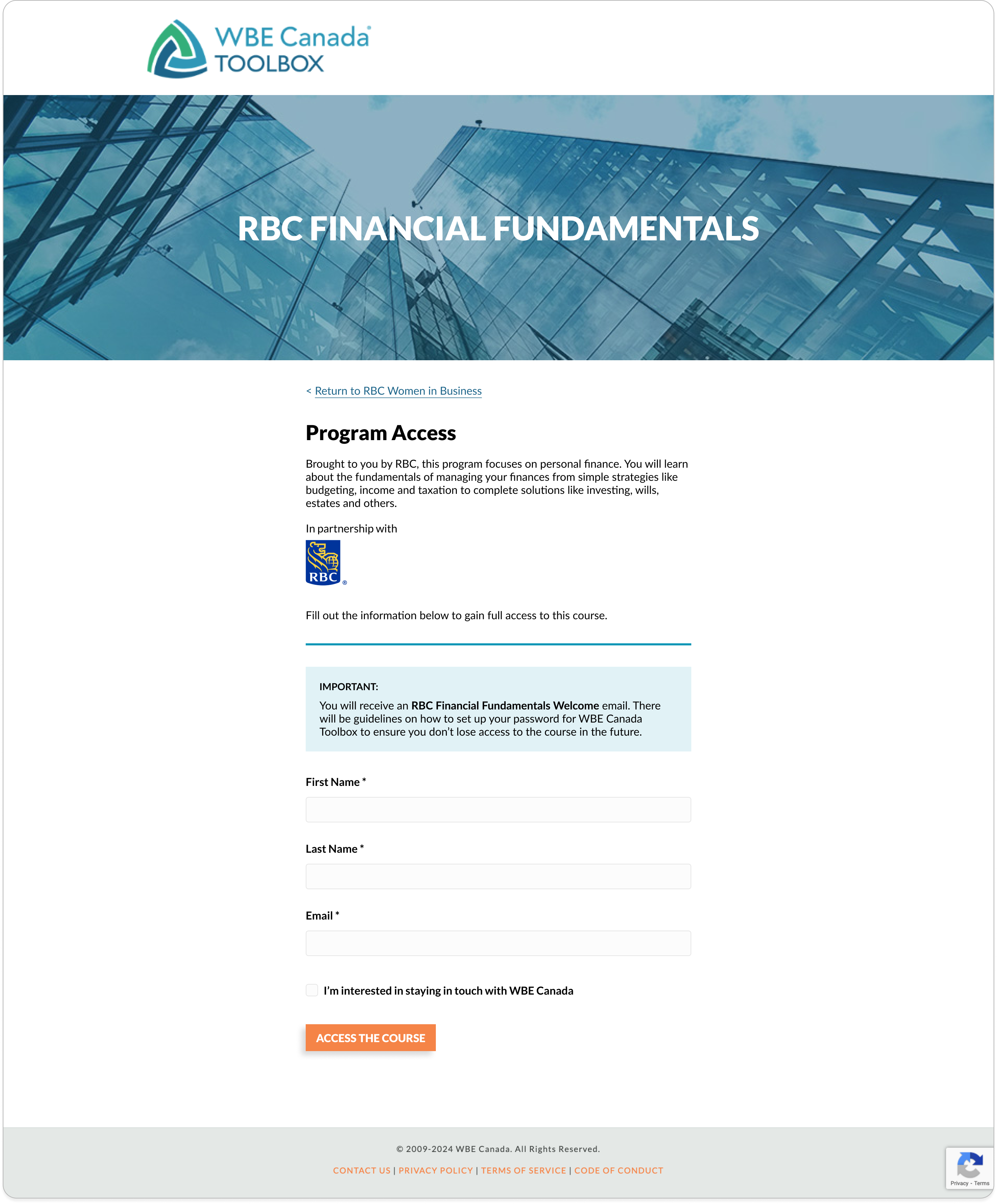
The final experience brought every constraint and decision together into a single coherent flow.
RBC clients arrive on a branded access page that opens with a clear "In partnership with RBC" note, anchoring the handoff between the two organizations from the first screen to establish trust. A first-time-user notification tells newcomers to expect a follow-up email with password-setup instructions, closing the platform's biggest onboarding gap before it becomes a point of confusion. A single opt-in checkbox lets users choose whether they want to stay in touch with WBE Canada, capturing interest without adding friction or compromising RBC client privacy.
Once inside the course, users are never stranded. A clear path back to RBC returns them to the Women Entrepreneurs initiative page, and a dedicated section promotes additional WBE Canada resources, including the certification and pathfinder programs, keeping both organizations' support for women entrepreneurs visible throughout the journey.
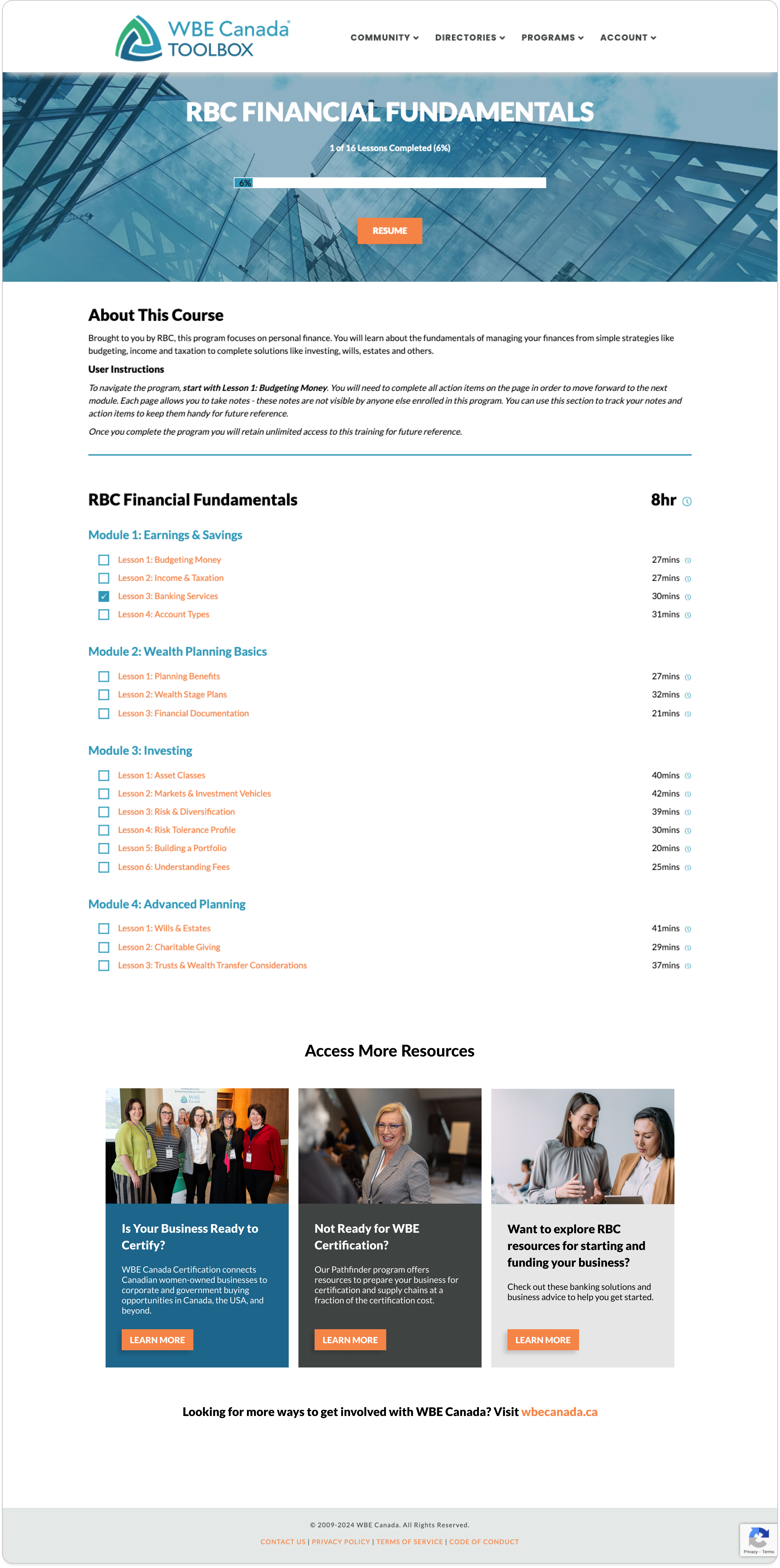
Since launch, the portal has brought 40 new opted-in contacts into WBE Canada's pipeline, each a potential women-owned business connecting with the organization for the first time. For a gated resource that was never publicly promoted and only reachable through two specific RBC pages, these are qualified, self-selected leads. The mechanism I designed to turn a static content link into a relationship channel is doing exactly what it was built to do.
Beyond the numbers, the project shipped through the approval of a major national bank's marketing, branding, and legal teams, and delivered a working handoff between two organizations with no shared infrastructure.
The hardest and most valuable part of this project was designing within hard constraints I couldn't remove. There was no budget for custom authentication, no shared login, and a platform with real limitations. The work wasn't about the ideal solution, it was about making defensible tradeoffs and shipping something that served both organizations.
I also learned how cross-organizational projects actually move. A single branding question pulled in three RBC teams and reshaped the timeline, and staying ahead of those dependencies mattered as much as any design decision.
If I were to do this again, I'd map the stakeholder and approval chain earlier, especially the legal touchpoints, so the sign-off dependencies were visible from the start rather than surfacing mid-project.


